
Many Millennial professionals wake up feeling like their work lacks true meaning, even with a promising title on their resume. This quiet sense of emptiness is more common than ever as traditional measures of success no longer deliver personal fulfillment. The Japanese concept of Ikigai shifts the focus from productivity and ambition to discovering what genuinely gives your life value, blending present-moment awareness, community connection, and personal passion. Explore how Ikigai offers a path toward deeper satisfaction and authentic purpose beyond career achievements.
Table of Contents
- Defining Ikigai: Origins And Core Philosophy
- Misconceptions About Ikigai In Western Contexts
- The Four Pillars Of Ikigai Explained
- Ikigai’s Role In Career And Daily Life
- Ikigai And Its Impact On Mental Wellness
- Practical Steps To Discover Your Ikigai
Key Takeaways
| Point | Details |
|---|---|
| Understanding Ikigai | Ikigai is a Japanese concept that emphasizes the pursuit of personal fulfillment through a balance of passion, vocation, mission, and profession. |
| Holistic Philosophy | Unlike Western views focused on productivity, Ikigai promotes a deep connection with community and meaningful engagement in daily life. |
| Mental Wellness Benefits | Practicing Ikigai can enhance psychological resilience and reduce stress by aligning daily activities with one’s deeper values. |
| Continuous Journey | Discovering your Ikigai is an ongoing process that involves self-reflection, exploration of passions, and engagement with community contributions. |
Defining Ikigai: Origins and Core Philosophy
Ikigai is a profound Japanese philosophical concept that transcends simple definitions of purpose or happiness. Rooted deeply in Japanese cultural understanding, the term literally combines ‘iki’ (life) and ‘gai’ (value or worth), representing a holistic approach to discovering one’s reason for being.
The origins of Ikigai are deeply embedded in Japanese societal values, emphasizing connection, mindfulness, and finding meaning in everyday experiences. Unlike Western productivity-focused philosophies, Ikigai centers on a more nuanced exploration of personal fulfillment that integrates individual passions with community contribution. This unique cultural perspective highlights the importance of present-moment engagement over future achievements.
Key characteristics of Ikigai include:
- Intrinsic motivation driven by personal passion
- Alignment between individual talents and societal needs
- Recognition of life’s value beyond professional achievements
- Emphasis on continuous personal growth
- Celebration of small, meaningful daily activities
At its core, Ikigai represents a dynamic intersection between what you love, what you’re good at, what the world needs, and what you can be rewarded for. This multidimensional framework encourages individuals to look beyond traditional success metrics and discover a more authentic, sustainable sense of purpose.
Pro tip: Start mapping your personal Ikigai by reflecting on activities that simultaneously energize you, utilize your strengths, and contribute positively to your community.
Misconceptions About Ikigai in Western Contexts
Westernized interpretations of Ikigai frequently distort the original Japanese philosophical concept, reducing it to a simplistic career optimization framework. This misunderstanding typically emerges from a narrow perspective that prioritizes professional achievement and personal productivity over the holistic, community-centered approach inherent in the traditional understanding.
The most prevalent misconception is the popular Venn diagram that suggests Ikigai is merely about finding the perfect intersection between passion, profession, mission, and vocation. In reality, this graphic representation is a Western invention that fundamentally misrepresents the nuanced Japanese concept. Traditional Ikigai is less about achieving a perfect balance and more about finding meaning in everyday experiences, accepting life’s imperfections, and maintaining deep connections with one’s community.
Key misunderstandings about Ikigai in Western contexts include:
- Viewing it as a career optimization strategy
- Focusing exclusively on individual achievement
- Treating it as a linear, goal-oriented process
- Overlooking the importance of community and social connections
- Emphasizing financial success over personal fulfillment
Pro tip: Approach Ikigai as a holistic life philosophy, not a productivity hack, by embracing small daily moments and your interconnectedness with your community.
Here’s a summary comparing traditional Japanese Ikigai and common Western interpretations:
| Aspect | Traditional Ikigai | Western Interpretation |
|---|---|---|
| Focus | Holistic life meaning | Career and productivity |
| Community Importance | Central to fulfillment | Often overlooked |
| Process Nature | Evolving and fluid | Linear and goal-directed |
| Success Measurement | Internal satisfaction | External achievement |
| View of Imperfection | Acceptance and integration | Seeking perfect balance |
The Four Pillars of Ikigai Explained
Ikigai’s fundamental framework represents a holistic approach to understanding personal purpose through four interconnected dimensions. These pillars are not simply checkboxes to tick off, but dynamic elements that interact and evolve throughout one’s life journey, creating a rich tapestry of meaning and fulfillment.
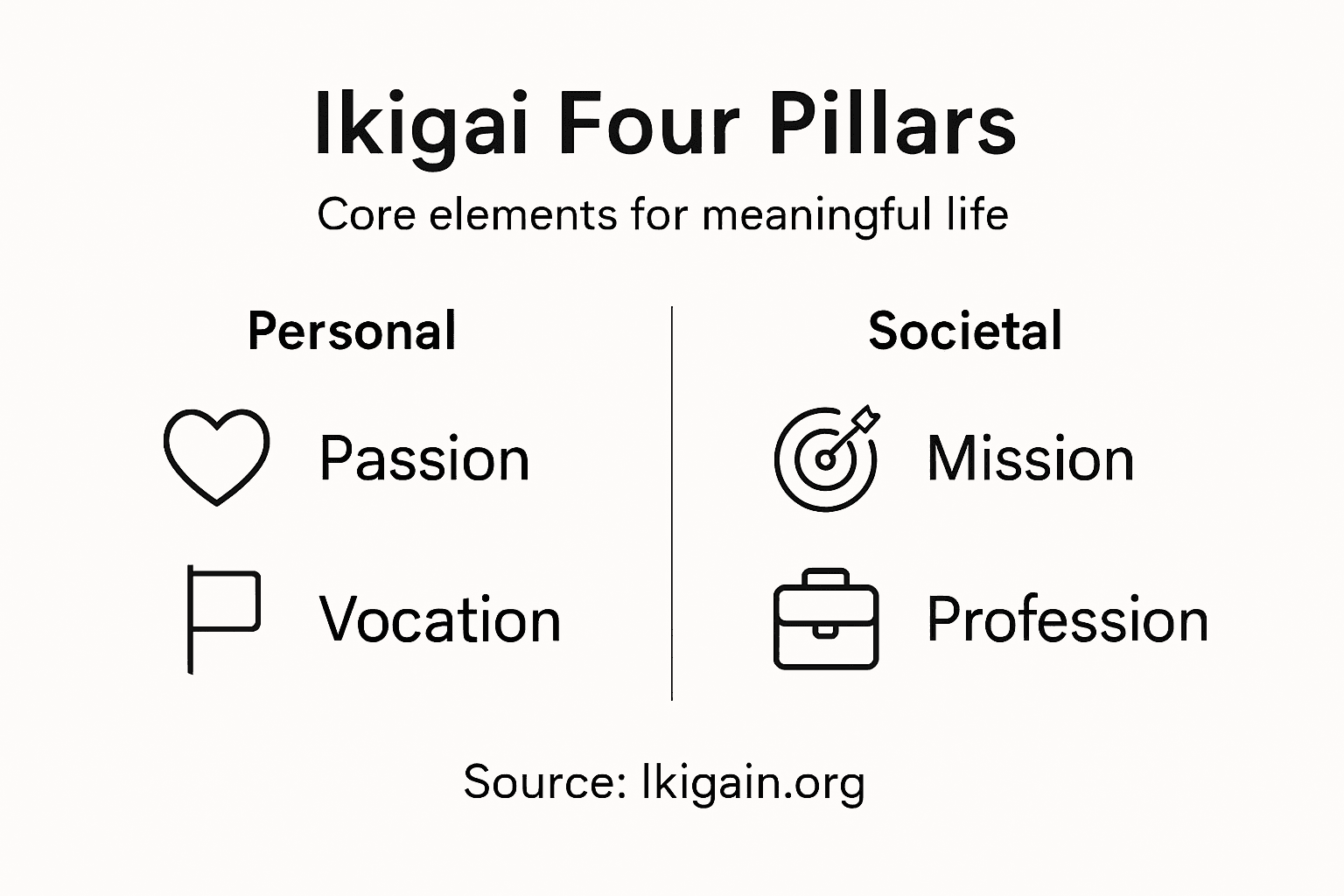
The four pillars of Ikigai represent distinct yet overlapping aspects of personal purpose: What you love (passion), what you are good at (vocation), what the world needs (mission), and what you can be paid for (profession). While these elements might seem straightforward, the true essence of Ikigai lies in understanding how these dimensions interact and complement each other, rather than viewing them as isolated components.
Key characteristics of each pillar include:
- Passion (What You Love): Activities that ignite intrinsic motivation and bring genuine joy
- Vocation (What You Are Good At): Skills and talents that you have developed and can perform with excellence
- Mission (What the World Needs): Opportunities to contribute meaningfully to society
- Profession (What You Can Be Paid For): Economic activities that sustain your lifestyle
The magic of Ikigai emerges when these four pillars intersect, creating a harmonious space where personal satisfaction, professional fulfillment, and societal contribution converge. This intersection is not about achieving perfect balance, but about recognizing the fluid, dynamic nature of personal purpose.
Pro tip: Regularly reflect on how your current activities align with each of the four pillars, allowing yourself flexibility and compassion as your understanding evolves.
Use this table to guide your self-assessment across the Ikigai pillars:
| Pillar | Self-Reflection Question | Example Indicator |
|---|---|---|
| Passion | What activities excite me? | Losing track of time while doing |
| Vocation | What am I naturally skilled at? | Others seek my help |
| Mission | How do I help my community? | Volunteering or activism |
| Profession | What can I be paid for? | Earning income consistently |
Ikigai’s Role in Career and Daily Life
Professional approaches in Japan demonstrate how Ikigai transforms work from a mere economic transaction into a deeply meaningful personal and social experience. Unlike Western models that often separate professional and personal identities, Ikigai encourages individuals to view their careers as integral extensions of their broader life purpose.

In career development and personal growth, Ikigai serves as a holistic framework that goes beyond traditional goal-setting. It helps individuals align their professional trajectories with personal passions, societal needs, and economic realities. This approach supports more intentional career choices that are not just financially sustainable but also emotionally and spiritually fulfilling.
Key dimensions of Ikigai in career and daily life include:
- Transforming work into a form of personal expression
- Finding meaning in routine daily activities
- Integrating personal skills with societal contributions
- Viewing professional challenges as opportunities for growth
- Balancing economic needs with personal satisfaction
Ikigai is not about achieving perfection, but about finding purpose in the journey of continuous personal and professional development.
Pro tip: Conduct a quarterly self-assessment mapping your current activities against the four Ikigai pillars to ensure ongoing alignment and personal growth.
Ikigai and Its Impact on Mental Wellness
Mental wellness research in Okinawa reveals a profound connection between having a sense of purpose and psychological well-being. Ikigai transcends traditional mental health approaches by offering a holistic framework that integrates personal meaning, social connection, and psychological resilience into a comprehensive approach to emotional health.
At its core, Ikigai supports mental wellness by redirecting focus from external achievements to internal satisfaction and meaningful engagement. By encouraging individuals to align their daily activities with their deeper values and societal contributions, the philosophy provides a powerful antidote to modern challenges like burnout, anxiety, and existential disconnection.
Key mental wellness benefits of practicing Ikigai include:
- Reducing stress through purposeful living
- Enhancing psychological resilience
- Promoting a sense of belonging and social connection
- Mitigating symptoms of depression and anxiety
- Developing a more positive and adaptive mindset
Mental wellness is not about eliminating challenges, but about developing the inner resources to navigate life’s complexities with grace and purpose.
Pro tip: Create a weekly reflection journal documenting activities that provide a sense of meaning, helping you progressively align your life with your Ikigai.
Practical Steps to Discover Your Ikigai
Mindful exploration of personal purpose requires a deliberate and introspective approach that goes beyond conventional self-discovery techniques. Uncovering your Ikigai is not about finding a single, fixed answer, but engaging in a continuous journey of self-understanding and alignment with your deeper values and potential.
The process of discovering your Ikigai involves a systematic yet deeply personal investigation into your passions, skills, societal contributions, and economic potential. This exploration demands honest self-reflection, willingness to experiment, and openness to evolving perspectives about your life’s purpose and meaningful engagement.
Practical steps to discover your Ikigai include:
- Conduct a comprehensive personal skills and passion inventory
- Identify activities that simultaneously energize and challenge you
- Explore potential societal contributions aligned with your talents
- Reflect on moments of flow and genuine satisfaction
- Experiment with diverse experiences to broaden self-understanding
- Document insights through journaling and periodic self-assessment
Discovering your Ikigai is not a destination, but a continuous journey of growth, curiosity, and self-discovery.
Pro tip: Create a monthly reflection practice where you honestly evaluate your activities against the four Ikigai pillars, allowing yourself flexibility and compassionate self-exploration.
Discover Your True Ikigai and Transform Your Life Fulfillment
The article highlights the challenge many face in finding lasting purpose by balancing passion, skills, societal contribution, and livelihood. If you feel stuck trying to understand your deeper motivations or confused by oversimplified interpretations of Ikigai, you are not alone. Key concepts like embracing daily meaningful moments and aligning your life with core values are easier said than done without personalized guidance.
At Ikigain.org, we offer a scientifically designed personality test that helps you uncover your unique Ikigai by revealing your true passions, strengths, and values. This tool goes beyond vague advice by providing tailored insights to guide your career, personal growth, and mental wellness in a way that respects traditional Japanese philosophy blended with modern self-discovery. Discover how to thoughtfully integrate the four pillars of Ikigai into your daily life and overcome the common pitfalls of misunderstanding its holistic nature.

Take the first step towards authentic life fulfillment now by exploring our comprehensive assessment and resources. Visit Ikigain.org to start your journey and experience a purpose-driven life. Your Ikigai is waiting to be found—don’t wait any longer. Learn more and get started today.
Frequently Asked Questions
What is Ikigai and why is it important for life fulfillment?
Ikigai is a Japanese concept that means ‘a reason for being.’ It emphasizes finding personal significance through the intersection of passion, vocation, mission, and profession. Understanding your Ikigai can lead to a more meaningful and fulfilling life by aligning your activities with your inner values and community contributions.
How can I start discovering my Ikigai?
To discover your Ikigai, engage in introspective practices such as conducting a personal skills and passion inventory, exploring societal contributions that resonate with you, and reflecting on experiences that bring you joy and fulfillment. Journaling and periodic self-assessment can also aid in clarifying your path.
What are the four pillars of Ikigai?
The four pillars of Ikigai are: 1) Passion (What You Love), 2) Vocation (What You Are Good At), 3) Mission (What the World Needs), and 4) Profession (What You Can Be Paid For). These elements interact dynamically to create a holistic sense of purpose and fulfillment.
How does practicing Ikigai contribute to mental wellness?
Practicing Ikigai promotes mental wellness by encouraging meaningful engagement and social connections, which can alleviate stress and enhance resilience. It helps individuals focus on internal fulfillment rather than external validation, fostering a positive mindset and reducing symptoms of anxiety and depression.


