
Feeling burnout after years of career success can leave even the most driven professionals questioning what truly matters. While Western self-help trends often disappoint, the Japanese concept of ‘reason for being’ known as ikigai offers a different path rooted in centuries of wisdom from places like Okinawa. For those ready to find fulfilling direction, exploring ikigai blends passion, social value, and stability into a practical method for long-lasting satisfaction.
Table of Contents
- Ikigai Method: Core Philosophy And Origins
- Personalized Testing For Career Direction
- Integrating Japanese Principles With Modern Wellness
- Benefits Over Traditional Self-Discovery Approaches
- Common Pitfalls When Seeking Purpose
Key Takeaways
| Point | Details |
|---|---|
| Holistic Integration | Ikigai blends passion, skills, societal needs, and financial security to create a sustainable sense of purpose. |
| Cultural Depth | Rooted in Japanese philosophy, ikigai emphasizes meaningful living, unlike many Western self-help approaches. |
| Personalized Testing | Ikigai-based assessments examine multiple dimensions of your life to reveal fulfilling career paths that traditional tests miss. |
| Purpose Evolution | Understand that purpose is not a fixed destination; it evolves and deepens through action and experience. |
Ikigai Method: Core Philosophy and Origins
Ikigai represents far more than a trendy self-help concept. This “reason for being” originated in Japanese culture, particularly rooted in the island of Okinawa, where it has been integral to daily life for centuries. Unlike Western approaches to purpose that often feel disconnected from reality, ikigai emerged from the lived experiences of Japanese communities navigating work, relationships, and meaning-making.
The philosophy draws from multiple cultural streams. Buddhist philosophy and ancient Greek thoughts on purpose.pdf) influence ikigai’s foundations, creating a uniquely blended worldview. This fusion explains why the concept resonates globally while retaining its distinctly Japanese character.
At its core, ikigai operates on a simple yet powerful principle: alignment between what you love, what the world needs, what you’re skilled at, and what sustains you financially. Think of these as four overlapping circles. When they intersect, you discover not just happiness, but a sustainable sense of purpose that actually lasts.
Here’s what makes ikigai different from typical Western goal-setting:
- Holistic integration: It balances passion with duty, personal desires with societal contribution
- Longevity focus: Born from regions famous for living well into their 100s, ikigai prioritizes sustainable fulfillment, not quick wins
- Cultural depth: Rooted in centuries of Japanese wisdom rather than marketing trends
- Practical applicability: Works across careers, industries, and life stages
The method gained global attention after research highlighted connections between ikigai and exceptional well-being outcomes in Okinawa. People practicing this philosophy reported lower stress, deeper satisfaction, and remarkable health outcomes. That’s not coincidental—when your daily actions align with your authentic purpose, your entire system benefits.
Ikigai solves the modern crisis where people spend 40+ years in careers that don’t feel meaningful, then wonder why burnout happened.
For professionals in your situation—successful on paper but spiritually depleted—ikigai offers something different than traditional career counseling. It asks not “What pays well?” but “What arrangement of your talents, passions, and values creates genuine fulfillment?” Understanding how to discover your purpose becomes essential when you’re ready to move beyond surface-level career satisfaction.
The philosophy acknowledges a hard truth: money alone doesn’t sustain meaning. Neither do accolades. But when your work satisfies all four dimensions simultaneously—when it engages your passion, uses your abilities, addresses real needs, and provides security—something shifts internally. That’s ikigai operating as intended.
Pro tip: Don’t expect to identify your full ikigai overnight. Professionals typically need 4-6 weeks of reflection, guided exploration, and honest assessment to uncover patterns you’ve been too busy to notice.
Personalized Testing for Career Direction
Most career tests stop at identifying your strengths and interests. Then they leave you hanging—wondering how to actually build a life around that information. Ikigai-based testing takes a fundamentally different approach by examining four dimensions simultaneously rather than isolating one or two.
When you take a personalized ikigai assessment, you’re not just answering questions about what you’re good at. You’re exploring the intersection of your passions, your natural abilities, what the world actually needs, and what generates sustainable income. This multidimensional perspective reveals career paths that traditional testing completely misses.
Here’s what makes ikigai testing distinct from conventional career assessments:
- Values integration: Reveals what genuinely matters to you, not generic career categories
- Sustainability focus: Identifies paths you can maintain for decades, not just next year
- Contribution clarity: Connects your work to meaningful impact beyond personal gain
- Economic reality: Balances purpose with the financial security you need
The testing process typically unfolds across five structured implementation steps covering multiple dimensions. Each phase builds on previous insights, helping you move from abstract reflection to concrete career direction. You’re not rushing to conclusions—you’re excavating your actual motivations.
Personalized ikigai testing reveals why you’ve succeeded in roles that still felt empty—and what to do about it.
For professionals at your stage, this matters because you’ve already proven you can perform well. The question now is whether your performance aligns with your authentic purpose. A standard personality test won’t answer that. But a comprehensive ikigai assessment will expose the gap between what you’re doing and what energizes you.
The testing identifies specific intersection points—those rare career territories where all four circles overlap. These aren’t fantasy roles. They’re concrete positions that combine your existing talents, leverage your real passions, address genuine market needs, and provide the income level you require.
One critical advantage: these assessments are culturally informed yet universally applicable. They respect the ikigai framework’s Japanese philosophical roots while adapting to your specific professional context. That blend prevents the disconnect you feel when Western career counseling ignores the meaning-making dimensions you actually care about.
Pro tip: Schedule your initial assessment when you have uninterrupted time to reflect honestly—early morning or a quiet weekend works best. Rushed answers produce generic results; thoughtful answers reveal your authentic direction.
Integrating Japanese Principles With Modern Wellness
Western wellness programs typically focus on individual optimization: exercise routines, nutrition plans, stress management techniques. But they often miss something crucial—the integration of purpose, community, and spiritual grounding that sustains long-term well-being.

Japanese wellness philosophies operate differently. Rather than isolating wellness into separate categories, they weave together personal health with meaningful living and social contribution. That’s where ikigai intersects with modern wellness in ways that transform outcomes.
The integration works because Japanese concepts address dimensions Western approaches overlook. Consider what happens when you add purposeful living to your wellness routine—suddenly exercise becomes meaningful rather than obligatory. Nutrition aligns with values rather than trends. Sleep improves because your mind rests, not races.
Here’s what shifts when you blend Japanese philosophy with contemporary wellness:
- Imperfection acceptance: Removes the perfectionism that sabotages most wellness programs
- Continuous, sustainable improvement: Replaces the all-or-nothing mentality that creates burnout
- Meaning integration: Connects daily health practices to your larger life purpose
- Community awareness: Balances individual wellness with social and spiritual values
Research shows that Japanese traditions like mindfulness, embedded within cultural and spiritual contexts, produce deeper wellness outcomes than isolated Western techniques. This isn’t coincidence. When a wellness practice carries cultural meaning and connects to something larger than yourself, adherence increases dramatically.
Wellness fails when it becomes another achievement to check off. It succeeds when it aligns with who you actually want to be.
For professionals managing burnout, this integration offers real relief. You stop treating wellness as separate from work—instead, you redesign work itself through the ikigai lens. Suddenly, your career contributes to your well-being rather than destroying it.
The practical application combines three core Japanese concepts: wabi-sabi teaches acceptance of imperfection, kaizen enables gradual improvement without pressure, and ikigai provides the directional compass. Together, they create sustainable wellness that doesn’t require willpower—it requires alignment.
This approach prevents the wellness-guilt cycle. You’re not failing because you skipped the gym. You’re succeeding because you’re building practices that genuinely serve your authentic life direction.
This table highlights key Japanese wellness philosophies and their practical effects:
| Philosophy | Core Principle | Impact on Well-being |
|---|---|---|
| Ikigai | Aligns purpose with daily actions | Increases fulfillment and resilience |
| Wabi-Sabi | Embraces imperfection | Reduces stress and perfectionism |
| Kaizen | Fosters gradual improvement | Supports sustainable habit formation |
Pro tip: Start with one small practice—a 10-minute morning reflection, a weekly walk with intention, or journaling about your values. Let it become natural before layering additional wellness practices. Sustainable wellness builds slowly, not dramatically.
Benefits Over Traditional Self-Discovery Approaches
You’ve probably taken personality tests before. Myers-Briggs. StrengthsFinder. DiSC assessments. Each one told you something useful about how you operate. But then what? You’re left with a label and a vague sense of direction, not a concrete path forward.
Traditional self-discovery approaches isolate variables. They measure personality traits, communication style, or core strengths independently. The problem: real life doesn’t work that way. You don’t function as a collection of isolated traits—you function as an integrated whole within specific contexts and relationships.
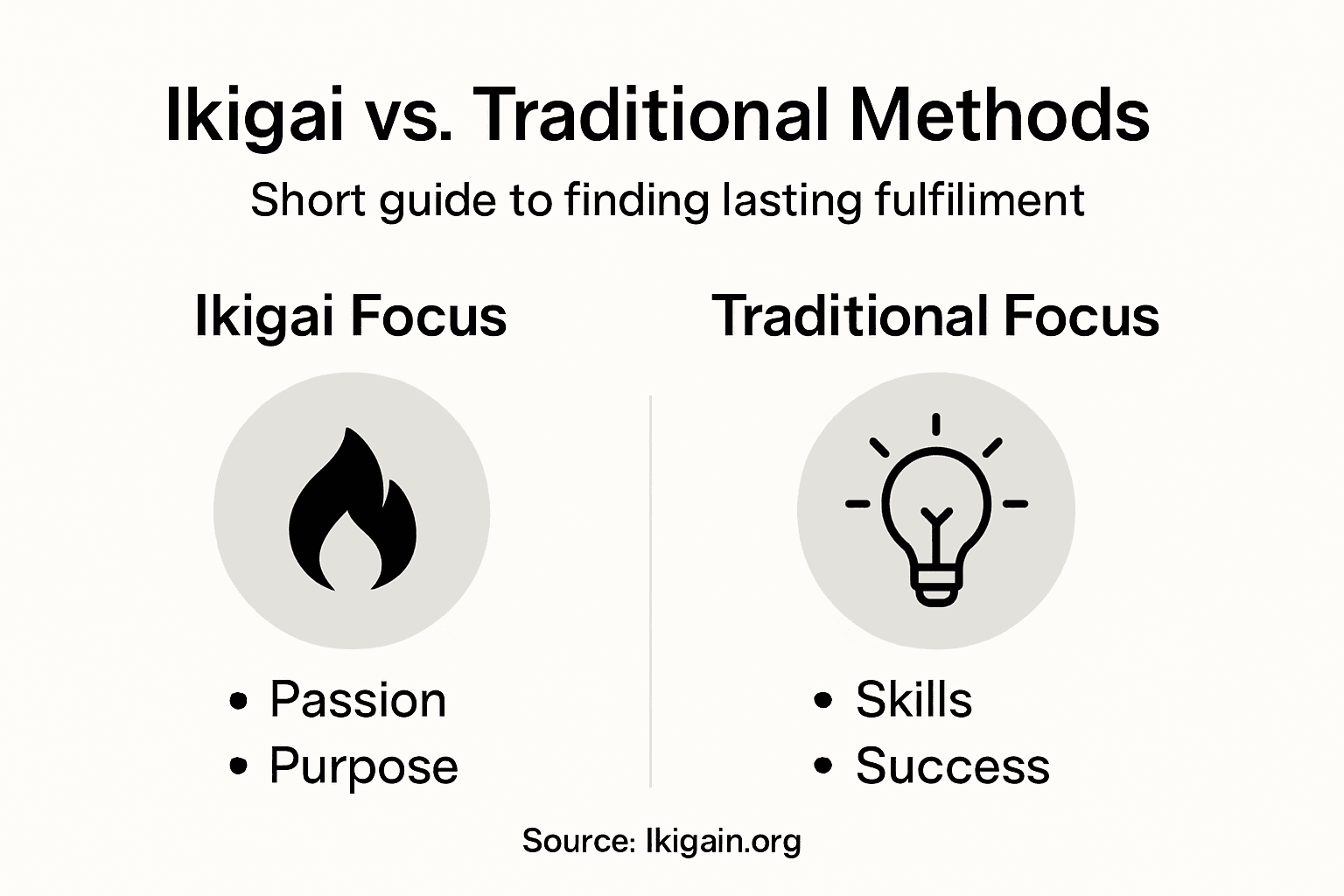
Ikigai changes the equation by examining four intersecting dimensions simultaneously. This integrated perspective reveals possibilities that single-lens assessments completely miss. It’s like comparing a black-and-white photo to a color image—the information density shifts entirely.
Here’s what separates ikigai from conventional self-discovery methods:
- Holistic integration: Examines passion, ability, market need, and financial viability together, not separately
- Purpose-driven outcomes: Produces concrete direction tied to meaning, not just personality insights
- Long-term sustainability: Identifies paths you can actually maintain across decades
- Mental health benefits: Positively influences depression reduction and improves life satisfaction
- Action-oriented results: Moves beyond self-knowledge into meaningful engagement
The mental health difference matters significantly. Traditional approaches tell you who you are. Ikigai tells you who you’re becoming and why it matters. That shift from passive self-understanding to active purpose-building produces measurable psychological improvements.
Traditional self-discovery answers “What am I good at?” Ikigai answers “What life arrangement would actually feel fulfilling?”
Research shows that ikigai complements and enriches therapeutic approaches by integrating cultural grounding with personal values. This cultural context prevents the alienation you often feel when Western self-help frameworks don’t match your actual values system.
Where traditional approaches stop, ikigai continues. You’re not left wondering how to apply your personality type. You have a concrete framework connecting your authentic self to meaningful action within the real world’s constraints and opportunities.
The benefits compound over time. Each quarter, you refine your understanding. Each year, alignment deepens. What started as self-discovery becomes self-actualization—continuous alignment between who you are and how you spend your days.
Here’s a comparison of Ikigai and traditional Western self-discovery approaches:
| Criterion | Ikigai Method | Western Self-Discovery |
|---|---|---|
| Focus | Integrates multiple life domains | Examines traits in isolation |
| Outcome | Sustained sense of purpose | Personality-based recommendations |
| Longevity | Encourages lifelong fulfillment | Often short-term direction |
| Cultural Roots | Centered in Japanese philosophy | Based on psychological frameworks |
| Actionability | Guides to specific roles | Leaves with general insights |
Pro tip: When comparing ikigai to previous self-discovery tools you’ve tried, notice what each revealed but didn’t act upon. Ikigai should illuminate both the insight and the specific next steps—not just insight alone.
Common Pitfalls When Seeking Purpose
Seeking purpose feels like it should be straightforward. You reflect, you discover what matters, you align your life accordingly. But most people stumble because they’re approaching the process with hidden assumptions that sabotage the outcome.
The biggest trap: hunting for one perfect answer. You think purpose is a fixed destination you’ll eventually find, then life becomes clear. That’s false. Purpose evolves as you do. It shifts with experience, changes with circumstance, and deepens through action.
Many professionals waste months in contemplation waiting for absolute certainty before moving. You analyze endlessly. Read books. Take tests. Journal extensively. But without action, you never test your assumptions against reality. Clarity comes through experimentation, not pure reflection.
Here are the most common derailments on the purpose journey:
- The perfection trap: Waiting for certainty before taking any action
- Others’ expectations dominating: Building a life around what parents, partners, or society expects
- Fear of failure paralysis: Avoiding exploration because the path might not work out
- Endless contemplation: Overthinking without experimenting
- Rigid thinking: Treating purpose as fixed rather than fluid and evolving
The second major pitfall involves living according to expectations that aren’t actually yours. You achieved the promotion because it looked good. You pursued the degree because it was expected. Now you’re successful on paper but hollow inside. This happens because you never paused to ask whether these achievements aligned with your authentic values.
You can spend 20 years accomplishing the wrong thing beautifully. Purpose work demands brutal honesty about whose definition of success you’re actually living.
Another trap: treating setbacks as evidence you’re on the wrong path. One project fails, one relationship ends, one career move disappoints—and you conclude your entire direction is wrong. Real purpose-building involves iterating, failing, learning, and adjusting. Not abandoning the search.
Many also underestimate how long meaningful alignment takes. You can’t rush this. Your brain needs time to integrate new information, test possibilities, and gradually shift perspective. Patience becomes part of the practice.
The solution isn’t to overthink differently—it’s to think and act simultaneously. Small experiments reveal what reflection alone cannot. Try the side project. Take the informational interview. Volunteer in the space that intrigues you. Each action generates real feedback.
Pro tip: Set a 30-day action target alongside your reflection work. If you haven’t tried something concrete toward a potential direction within a month, you’re contemplating instead of discovering. Real purpose emerges from doing, not just thinking.
Discover Your Ikigai and Transform Your Life Today
If you have ever felt successful on paper but empty inside or found yourself stuck in the cycle of burnout and meaningless achievement, the Ikigai Method offers a powerful solution. This approach directly addresses the struggle of finding lasting fulfillment by helping you explore the intersection of your passions, skills, values, and financial needs. Instead of chasing quick fixes or generic career advice, embrace a holistic path that has guided Okinawans to longevity and deep satisfaction.
Take the first step toward meaningful living with the comprehensive personality test at Ikigain.org. Our scientifically-backed assessment uncovers your unique ikigai by blending timeless Japanese wisdom with modern self-discovery techniques. Don’t wait to feel aligned with who you truly are and what makes your life worthwhile. Visit Ikigain.org now and start your journey toward a career and lifestyle that genuinely nourish your well-being and purpose. Explore more insights on why discovering your purpose matters and learn how you can integrate this transformative philosophy into your everyday life.
Frequently Asked Questions
What is the Ikigai Method?
The Ikigai Method is a Japanese philosophy that emphasizes finding your unique reason for being by aligning what you love, what you’re skilled at, what the world needs, and what provides financial sustainability.
How can the Ikigai Method help with burnout?
The Ikigai Method helps individuals struggling with burnout by promoting alignment between their work and authentic purpose, leading to increased satisfaction and well-being in both personal and professional life.
How does the Ikigai approach differ from traditional career counseling?
Unlike traditional career counseling, which often focuses on financial gain, the Ikigai approach integrates passion, skills, societal needs, and financial stability, placing greater emphasis on long-term fulfillment rather than short-term success.
What are the steps involved in personalized Ikigai testing?
Personalized Ikigai testing involves exploring four dimensions that encompass passions, skills, market needs, and financial viability through a structured implementation process that leads to concrete career direction.


